Property transaction history in Malaysia: how to check past sale prices online
Where to look up what a house, road or taman actually sold for, what each source costs, and how to read a road's sale history.
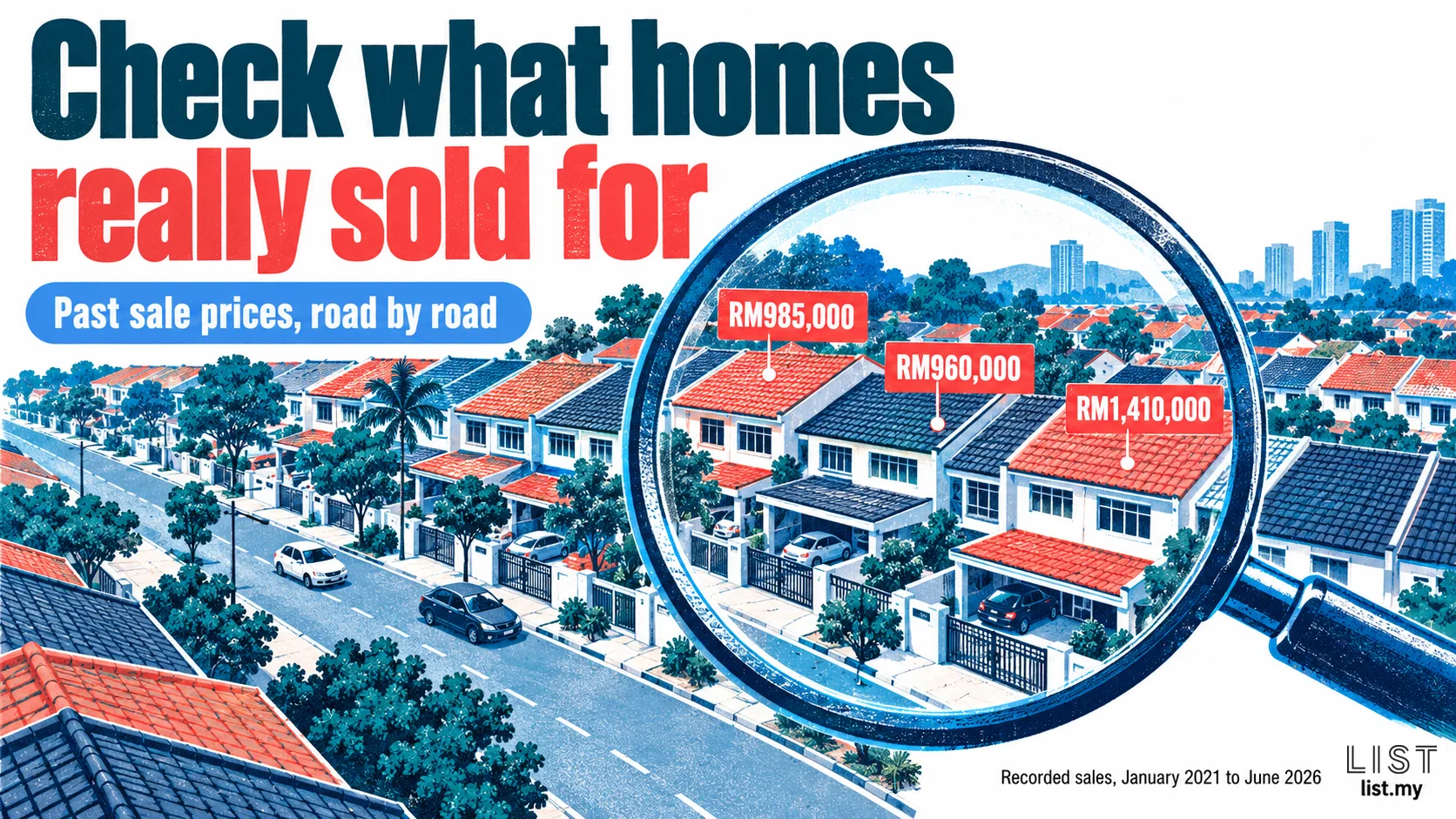
The short answer
You can check what a property sold for in Malaysia for free. Every recorded sale comes from JPPH, the government's Valuation and Property Services Department, and you can search it down to the road.
Checking transaction prices at a glance
- ✓ Free: NAPIC Open Sales Data and List.my show past sales from 2021
- ✓ Down to the road, never the house or unit number
- ✓ A few months behind: the newest month on List.my is June 2026
- ✓ Compare like with like: same road, same type, similar size, using psf
Where to check property transaction prices in Malaysia
There is one source and several ways in. The records all start at JPPH, which runs the National Property Information Centre (NAPIC). Our NAPIC guide explains who they are.
| Where | What you get | Cost | Good for |
|---|---|---|---|
| NAPIC Open Sales Data | Individual sales from 2021, filtered by state, district, property type, year and scheme name, with an Excel/CSV download | Free | Raw rows, if you're happy working in a spreadsheet |
| NAPIC e-Data | Unpublished and more detailed data, after you register | Paid; the fee is worked out from what your search returns | Valuers, researchers and the most recent month |
| Property portals | Transacted prices beside listings or in a transactions section, mostly from the same JPPH records | Often free summaries; some charge for detailed reports | A quick check while browsing listings |
| List.my | The same records, searchable from state down to road, with medians and psf worked out | Free | Comparing one property against its road and area |
NAPIC details checked on napic.jpph.gov.my on 14 October 2026. e-Data is paid online via DuitNow, and a month's transaction data goes on sale from the 15th of the following month.
About NAPIC's free data. Open Sales Data is an interactive table, not a search. Areas come in square metres, so you have to convert them and work out psf yourself. It is complete and official, and NAPIC's disclaimer asks you to verify the figures before you rely on them.
About portals. Several Malaysian portals show past transacted prices, often next to their listings. They draw on the same JPPH records, so the prices should match. They mostly differ in how much you can see for free. See our Brickz comparison.
What won't give you a price. A land title search at the land office (carian rasmi) tells you who owns a property and whether it is charged to a bank. It is not a price history. Bank valuations are never published.
Free transaction search
Look up a road's sale history
Search an area or road and see every recorded sale since 2021, with the median price and psf worked out for you.
How to check a property's sale history on List.my
- Find the place. Go to Subsales and search the taman, condo or road name. Or drill down: state, district, mukim, area, then road. For example, Selangor › Petaling › Bukit Raja › Bandar Setia Alam.
- Pick the property type. A double-storey terrace and a semi-D are different markets. Filter to the one you're pricing.
- Set the dates. Use 1Y or 2Y for the current market, or a custom range. Older sales are useful for trends, not today's price.
- Read the summary. Each page shows the median price, the median psf and the number of sales behind them. The middle price (median) ignores one-off extremes, which is why we use it.
- Group by size or road. Grouping shows which sizes and which streets sit above or below the area's median.
- Open the road. Each road page lists every recorded sale on that street since 2021, newest first.
- Open a single sale. You'll see the month, price, tenure, built-up area, land area, psf on both, and how it compares with similar homes in the area.
Want an email when new sales are recorded? Use Follow on any area or road page.
Worked example: Bandar Setia Alam, last 12 months
Bandar Setia Alam in Shah Alam is one of the Klang Valley's busiest landed townships. Here is what its records show for July 2025 to June 2026.
119 home sales were recorded, all landed:
- 78 double-storey terraces: median RM752,500, or RM465 psf. The middle half sold for about RM690,000 to RM920,000. See them.
- 25 double-storey semi-Ds: median RM1,800,000, or RM522 psf. See them.
- 10 bungalows and 6 other landed homes.
Five of those double-storey terrace sales, from cheapest to dearest:
| Month | Road | Built-up | Land | Price | psf |
|---|---|---|---|---|---|
| May 2026 | Jalan Setia Indah U13/11F | 1,259 sq ft | 1,173 sq ft | RM540,000 | RM429 |
| Apr 2026 | Jalan Setia Impian U13/6K | 1,625 sq ft | 1,650 sq ft | RM750,000 | RM461 |
| Jan 2026 | Jalan Setia Indah U13/9V | 1,959 sq ft | 1,647 sq ft | RM850,000 | RM434 |
| May 2026 | Jalan Setia Indah U13/10C | 1,518 sq ft | 4,402 sq ft | RM1,200,000 | RM791 |
| Nov 2025 | Jalan Setia Wawasan U13/32H | 4,026 sq ft | 2,519 sq ft | RM1,800,000 | RM447 |
Recorded subsale transactions, July 2025 to June 2026, from JPPH records on List.my. psf is on built-up area.
Same township, same property type, and prices from RM540,000 to RM1,800,000. Two things explain most of the gap:
- House size. The RM1,800,000 home has more than three times the built-up area of the cheapest one. Its psf is ordinary.
- Land. The RM1,200,000 sale has a 4,402 sq ft plot, more than two and a half times a typical lot. That is almost certainly a corner or end lot, and its psf on built-up area looks sky-high because of it.
This is why a township median is only a starting point. The real check happens at road level.
How to read a road's sale history
Take Jalan Setia Indah U13/9C, a road of double-storey terraces. It has 26 recorded sales from October 2022 to November 2025, with a median of RM995,000.
1. Find the standard house. Most of the road is identical: 1,959 sq ft built-up on a 1,647 sq ft plot. Fifteen of those sold between October 2022 and August 2023 for RM916,000 to RM998,000, median RM985,000. One more sold in July 2025 for RM1,030,000.
2. Spot the outliers and explain them. The newest sale, in November 2025, was RM1,410,000. Next to the road median, it looks like a jump of more than 40%. Open it and the land area is 3,035 sq ft, nearly twice the standard plot. Most of the gap is the bigger lot, not a rising road.
3. Compare like with like. Two other 3,035 sq ft lots on the same road sold in October 2022, for RM1,172,000 and RM1,270,000. Against those, the November 2025 sale is roughly 11% to 20% higher three years on. Three sales is thin evidence, but it is a far fairer read than the raw 40%.
4. Check the dates. Thirteen of the 26 sales were recorded in October 2022 alone. A burst of near-identical prices in one month can mean a newer phase handing over to its first buyers, whose prices follow the developer's price list rather than open-market negotiation.
5. Don't trust one row. One plot of 4,876 sq ft sold for RM995,000, no more than a standard house. A single odd record could be a family transfer or a quirk of the lot. Read the pattern, not one sale.
Quick rules for any road
- Use psf on the same basis. Built-up psf for houses and condos; don't mix it with land psf. See floor area vs land area.
- Match the size. Within about 10% of the home you're pricing is a sensible start.
- Prefer recent sales. The last one to two years, unless the road has too few.
- Use several sales, not one. A median of five or more tells you far more than a single price.
- Widen carefully. If your road has no recent sales, go to nearby roads in the same taman before the whole mukim.
What a transaction record shows, and what it doesn't
Recorded
- ✓ Price paid
- ✓ Month and year of the sale
- ✓ State, district, mukim, scheme or taman, and road
- ✓ Property type and tenure
- ✓ Built-up (main floor) area and land area
- ✓ Floor level for some high-rise units
Not recorded
- ✗ House or unit number
- ✗ The exact day of the sale
- ✗ Corner, end or intermediate lot
- ✗ Condition, renovation or furnishing
- ✗ View, facing or noise
- ✗ Whether it was a family transfer or a rushed sale
Expect a lag. A sale appears only after the transfer is stamped and processed by JPPH. As of 14 October 2026, the newest month on List.my is June 2026, so the most recent three to six months are always missing or thin. Don't read a quiet recent quarter as a slowdown.
More on the source in where our transaction data comes from. If a record looks wrong, tell us and we'll check it against the source.
From sale history to a price
Once you've read the road, you have a fair price range for the home in front of you. Two next steps:
- Get a range in one go. The property valuation tool pulls comparable recorded sales nearby, matched on type and size, and gives you an indicative range.
- Check the asking price. Our guide to checking market value covers bank value against market value, and what happens if the bank's valuation comes in low.
Transaction history is evidence, not a valuation. For a loan, an estate matter or anything binding, you'll still need a registered valuer or the bank's own valuation.
Figures are from recorded subsale transactions on List.my as of 14 October 2026 and will change as new records arrive. NAPIC services and fees were checked on 14 October 2026 and can change. General information only, not financial or legal advice.
Common questions
How can I check property transaction history in Malaysia online?
Use the government's records, which come from JPPH (the Valuation and Property Services Department). You can view them for free on NAPIC's Open Sales Data page, buy more detailed data through NAPIC e-Data, or search the same records by area and road on List.my, where the median price and psf are already worked out.
How do I check the transaction price of a property in Malaysia?
Find the property's area, then its road, and look at the recorded sales of the same property type and a similar size. On List.my, go to Subsales, search the taman or road, filter by type and date, and open any sale to see its price, built-up area, land area and psf.
Is property transaction data in Malaysia free?
Most of it, yes. NAPIC's Open Sales Data is free to view and download, and List.my is free to browse. NAPIC's e-Data service is paid, with the fee worked out from what your search returns. Some property portals show free summaries and charge for detailed reports.
Can I see the last transacted price of a specific house or condo unit?
Not by house or unit number. Records show the road and the scheme name, not the address. Look for sales on the same road with the same built-up and land area, which usually narrows it down to a handful of near-identical homes.
Why can't I find a sale that happened last month?
Transaction data runs a few months behind. A sale is recorded only after the transfer is stamped and processed. As of 14 October 2026, the newest month on List.my is June 2026.
How do I tell if a past sale was a corner or end lot?
Records don't say. Check the land area instead: on a road of identical terrace houses, a sale with a much bigger plot than the rest is very likely a corner or end lot. Open the sale on List.my to see its land area.
Help improve this guide
Spot a mistake or have a clearer example? Send us a correction or start a community discussion so the guide can improve over time.