How to check a property's market value in Malaysia
A practical guide to checking what a property is really worth using recorded transaction data.
Why asking prices mislead
When people ask how to check the market value of a property in Malaysia (cara semak harga rumah), they often start with listings. The problem is that a listing shows an asking price, and an asking price shows hope, not reality.
It helps to separate three different numbers. The asking price is what a seller wants. The market value is closer to what buyers and sellers actually agree to in completed deals. The bank valuation is a separate figure prepared by a licensed valuer, usually for a loan.
These three rarely match exactly. A seller can ask any price they like, but the market value (harga pasaran rumah) is set by what similar properties actually sold for.
Bank value vs market value
The pair that causes the most confusion is market value and bank value (nilai bank). Both purport to state what a property is worth, but they are produced by different parties, from different evidence, for different purposes.
| Market value | Bank value | |
|---|---|---|
| Who produces it | The market, through completed transactions | A registered valuer on the bank's panel |
| Based on | What comparable properties transacted at | An inspection together with comparable evidence, assessed conservatively |
| Used for | Pricing, negotiating, deciding whether to offer | Determining the quantum of financing |
| Available in advance | Yes, from recorded transactions | No, only once the bank instructs the valuer |
The critical point is that the purchaser does not choose the valuer. On application for a housing loan, the bank appoints a valuer from its own panel, and it is that valuer's figure against which financing is extended.
Why the difference costs money
Banks extend a margin of financing against the lower of the bank valuation and the price stated in the sale and purchase agreement (SPA). Where the valuation comes in below the agreed price, the shortfall — known as the differential sum — must be settled in cash by the purchaser.
Consider a property transacted at RM600,000 on a 90% margin of financing. Should the valuer concur with the agreed price, the bank advances RM540,000 and the purchaser funds RM60,000. Should the valuer instead return RM550,000, financing is computed on that lower figure — RM495,000 — and the cash requirement rises to RM105,000. The price has not moved; only the valuation has.
Banks may also revise or withdraw a financing offer where the valuation falls materially short of the agreed price. A shortfall is therefore best anticipated before the SPA is executed, not after.
What this means when you are checking prices
Panel valuers assess conservatively, so the customary order runs asking price, then market value, then bank value, from highest to lowest. Bank valuations are not published and there is no register against which to check one — so the candid answer to "cara semak bank value rumah" is that it cannot be ascertained in advance.
What can be examined is the evidence the valuer will be working from. Where an asking price sits materially above what comparable homes on the same road have recently transacted at, a valuation shortfall is likely, and the purchaser should budget for the differential sum or renegotiate. Where the price is consistent with nearby recorded deals, the valuation will usually follow.
For a full treatment of the margin of financing and down payment, see the real cost of buying a house.
Check actual transacted prices for free
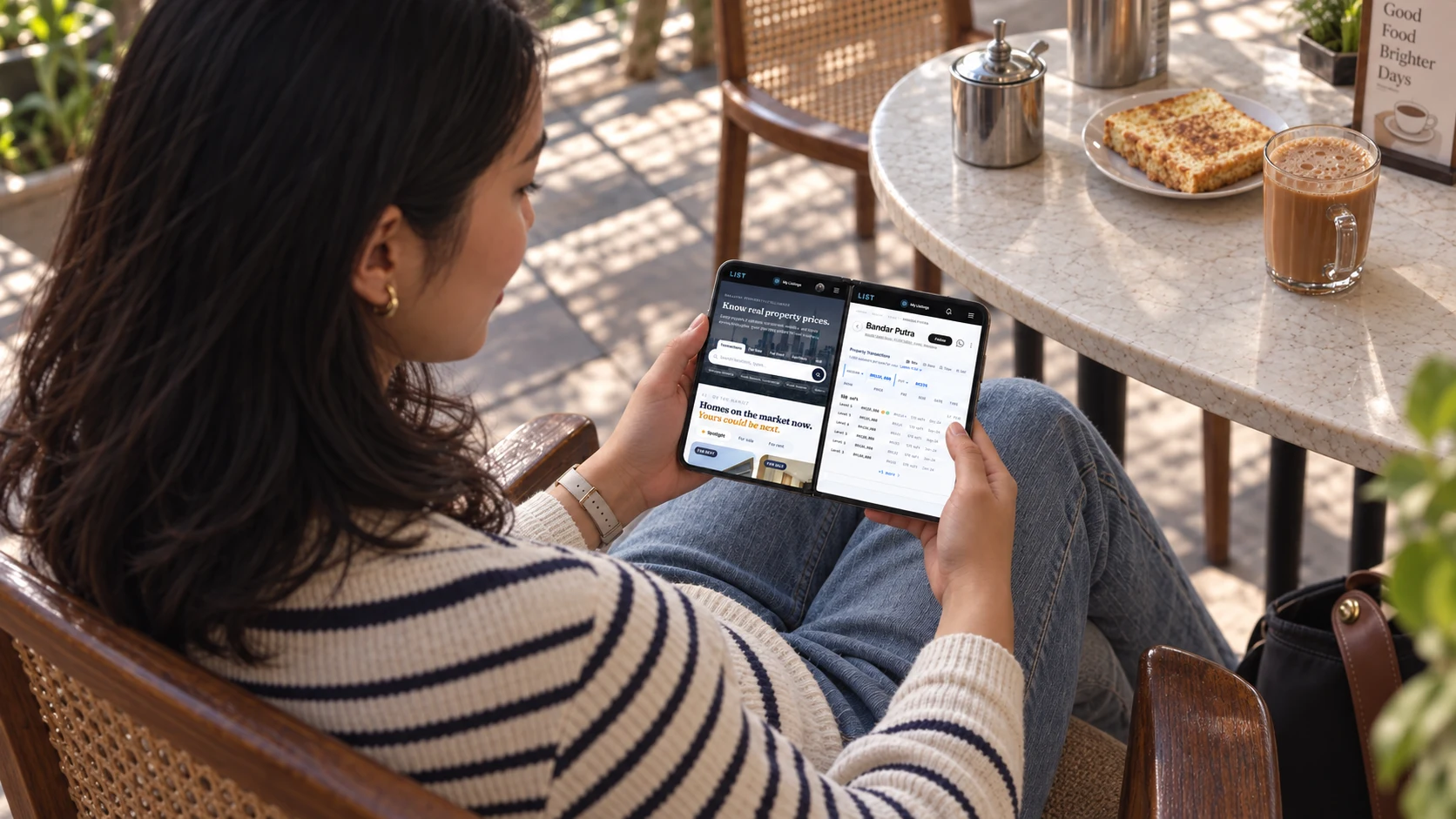
The most reliable way to check house value in Malaysia is to look at recorded transactions, not listings. Malaysia's subsale transactions are recorded through government data (NAPIC/JPPH), and List.my makes them browsable for free.
This directly answers a common question: can I check how much a house sold for? Yes, and here is how. On the subsales pages you drill down through the location hierarchy, from State to District to Area to Road, until you reach the neighbourhood you care about.
From there you can filter by property type and size, then open individual completed deals to see what buyers actually paid. You also see the median price for that group of transactions, which is a better summary than any single deal.
This is how to check property prices in your area (cara semak harga rumah) without paying for a report or guessing from asking prices.
Free tool
Check your property's market value now
Enter a property and we pull the recorded transactions nearby, matched on type and size, and show you the median range. No sign-up, no cost.
How to compare properly
Raw transaction numbers only help if you compare like with like. The closer the match, the more useful the figure.
Try to match on these where you can:
| Factor | Why it matters |
|---|---|
| Location | Same road or project is best; the next street can differ |
| Property type | A condo and a terrace house are not comparable |
| Size | A 900 sqft unit should not be compared to a 1,500 sqft one |
| Tenure | Freehold and leasehold can trade at different levels |
| Transaction date | Recent deals reflect current conditions better |
Prefer transactions in the same project or road before widening your search. Use the median, not the average, because one unusually high or low deal can distort an average badly. For more on why, read property median price and why median not average.
One common mistake is mixing size bases. Do not compare a price per square foot based on floor area against one based on land area, or the numbers will not line up. See floor area vs land area before you calculate anything per square foot.
Use a guided valuation tool
If you would rather not gather comparables by hand, use the free List.my property valuation tool. It finds recent comparable transactions for a property and presents them together, so you can see a reasonable range quickly.
This is a practical way to answer "berapa harga rumah saya" (how much is my house worth) as a starting estimate. It uses the same recorded transaction data, just gathered for you.
When you need a formal valuation
Data tools are a starting reference, not a formal valuation. As covered above, a loan application triggers the bank's own valuation — and a licensed valuer inspects the property, weighing things raw data cannot capture, such as renovation quality, condition, and legal status.
So treat everything above as a comparison guide, not a valuation or a guarantee of worth. It tells you whether an asking price looks reasonable; it does not replace a professional valuation, financing advice, or legal advice.
How List.my helps
List.my is useful because it shows recorded subsale transactions, not only asking prices. That lets you check a seller's expectation against what similar homes actually sold for, before you make an offer or accept one.
Start on the subsales pages, narrow the records by property type and size, then open the deals that look most comparable. When you are ready for a quicker read, run the property through the property valuation tool to pull nearby comparables into one place.
How to use the estimate, by who you are
The same estimate reads differently depending on why you are looking. Pick the one that fits.
Home buyer
You are negotiating a price and you do not want to overpay.
- Sanity-check the ask. Where the seller's price sits above the high end of the range, ask for the comparables that justify the premium.
- Anchor your offer near the estimate, or near the low end when the trend is flat or falling, and point to 3 to 5 of the comparables in writing.
- Allow for what the data cannot see: condition, renovation, facing, tower and stack. A freshly renovated unit can justify 5% to 10% above the estimate. A tired one should sit below it.
- Before you commit, get a bank valuation. It is effectively free once you apply for a loan, and it is the figure that sets your margin of financing.
Property investor
You care about yield, entry price and downside.
- Compare the estimate against rental yield. Where a unit costs RM X and rents at RM Y a month, gross yield is Y × 12 ÷ X. Below 3% is weak and 5% or more is healthy for Malaysian condominiums, though both depend on the area and the year.
- Read the trend and sentiment badges together. Negative sentiment with a declining trend suggests you can afford to be patient. Positive and rising is momentum, so check first that a bulk launch is not behind it.
- Compare neighbouring areas. Broaden to the mukim or district and run the estimate again. An area trading at a notable premium to its own mukim, with no obvious reason, is worth a closer look.
- Work in psf, not total price. Price per square foot is what lets you compare units of different sizes, and it exposes gaps between similar projects in the same area.
These are ways to read the data, not investment advice. Your own position, financing and tax treatment all change the answer.
Property agent (REN, REA or PEA)
You need to advise a client or set a listing price you can defend.
- Listing price. Set the asking price at the top of the range, or a little above, when confidence is high and the trend is up. Start near the estimate when confidence is medium or the market is soft.
- Acting for a buyer. Share the valuation link with your client. The URL is shareable and the comparables sit on the same page, which replaces "trust me" with an audit trail.
- Handling objections. When a seller insists their unit is worth 20% more, open the comparables and walk through them. The spread of real sales settles the argument faster than an opinion does.
- Read the confidence score as a story. Low confidence usually means thin liquidity. Price for a longer time on the market, not for a higher ask.
Property developer
You are setting launch prices or benchmarking a new project.
- Treat secondary-market psf as your resale ceiling. A launch priced well above it forces buyers to absorb the gap when they exit, and they will push back.
- Pick the right comparables. Run the estimate on 2 or 3 nearby projects of a similar age and tier. The median psf across those is your honest market-clearing number.
- Check liquidity, not just price. A high psf in an illiquid area is fragile, because buyers cannot exit. The comparable count is a direct proxy for that.
- Size your floor premium on purpose. The data shows the per-floor psf gradient the market actually pays. Charging more than that, without a view or layout to justify it, leaves upper-floor stock slower to clear.
Everyone else
- Renting and want a benchmark? Divide the estimate by 240 for a rough monthly rent, which is about a 5% gross yield. A quoted rent far above that is above market.
- Divorce or inheritance splits. Share the URL with the other party and a lawyer as a neutral, auditable starting number. A licensed valuer's report is still required for the stamped agreement.
- Estate executors and probate. Useful for a first-pass estate figure. A licensed valuer's letter is normally still needed for filing.
- Accountants and tax advisers. Handy for a Real Property Gains Tax base-price cross-check, an asset-revaluation note, or a fair-value estimate in management accounts.
- Journalists, researchers and students. Every valuation URL is citeable and reproducible, because the page keeps every parameter used to produce the estimate.
- Simply curious. Wondering what the neighbour's place is worth is a perfectly good reason.
One rule for everyone. The estimate is a starting point, not a final number. For any binding decision — a sale, a loan, a legal filing — pair it with a licensed valuer's report or a bank valuation.
For the formulas and thresholds behind the figure, see how we calculate the estimate.
Common questions
What is the difference between bank value and market value?
Market value is what comparable properties transact at, and it can be checked from recorded deals. Bank value is the figure assigned by a registered valuer on the bank's panel for lending purposes, and it is generally more conservative. Financing is extended against whichever is lower, the valuation or the agreed purchase price.
Can I check the bank value of a house before applying for a loan?
No. Bank valuations are not published and are produced only once a bank instructs a valuer from its own panel. The closest proxy is the transacted prices of comparable homes nearby, available on the subsales pages — where an asking price sits materially above those, a valuation shortfall should be expected.
What happens if the bank valuation is lower than the purchase price?
Financing is computed on the lower figure, so the difference — the differential sum — is payable in cash by the purchaser. On a RM600,000 purchase at a 90% margin of financing, a valuation of RM550,000 reduces the advance from RM540,000 to RM495,000 and raises the cash requirement from RM60,000 to RM105,000. Banks may also revise or withdraw an offer where the shortfall is substantial.
How do I check property prices in my area?
Browse recorded subsale transactions for your location instead of relying on asking prices. On List.my you drill down from state to district to area to road on the subsales pages, then filter by property type and size to see what similar homes actually sold for.
Can I check how much a house sold for in Malaysia?
Yes. Malaysian subsale transactions are recorded through government data (NAPIC/JPPH), and List.my makes them browsable for free. You can open individual completed deals and see the median price for similar properties in the same area.
What is the difference between market value and asking price?
The asking price is what a seller hopes to get, while market value is closer to what buyers and sellers actually agree to in completed deals. A bank valuation is a third figure, prepared by a licensed valuer for loan purposes.
Is there a free property valuation calculator in Malaysia?
List.my offers a free property valuation tool that finds comparable recorded transactions for a property. Treat it as a data-based starting reference, not a formal valuation.
How can I estimate the market price of my house (harga pasaran rumah)?
Look at recent transacted prices for similar properties nearby, matched on type, size, and tenure, and use the median rather than the average. This gives a realistic price range, though a licensed valuer is still needed for a formal valuation.
Help improve this guide
Spot a mistake or have a clearer example? Send us a correction or start a community discussion so the guide can improve over time.