Bank value vs market value: how to check a property's bank valuation in Malaysia
Why the bank's valuation is often lower than the price you agreed, how the loan is worked out from it, and what to do when it comes in short.
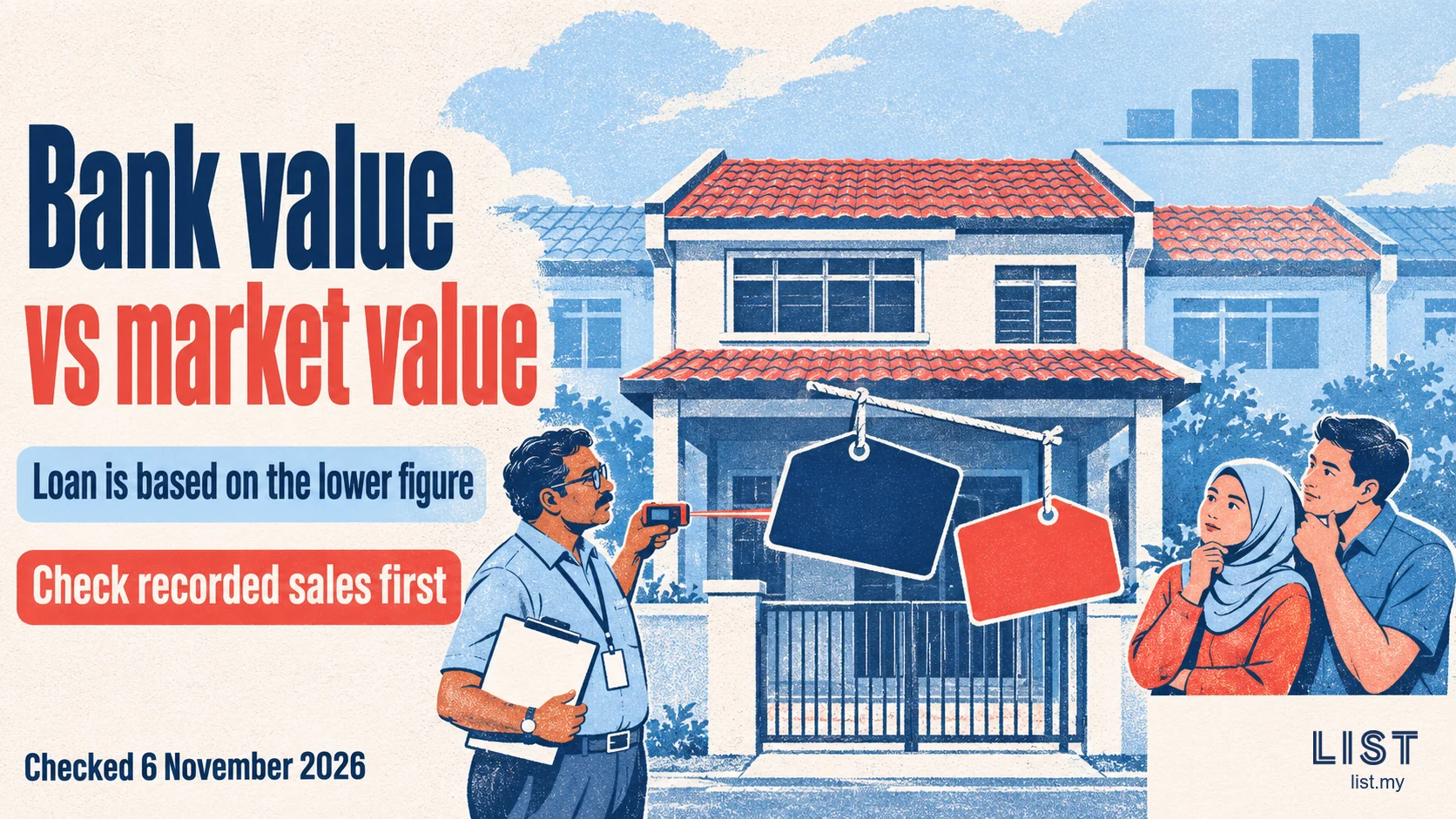
Bank value (often called nilai bank) is the figure a valuer on the bank's panel puts on a property when you apply for a housing loan. Your loan is based on the lower of that figure and the price you agreed with the seller. If the bank value comes in below the price, you pay the gap in cash.
At a glance
- Who values it: a registered valuer picked by the bank, not by you.
- How: mostly by comparing recent recorded sales of similar homes nearby.
- Loan: commonly up to 90% of the lower of price and valuation, 70% on a third housing loan.
- Can you look it up? No. You can check the recorded sales the valuer will use.
- If it comes in low: ask for a review, try another bank, renegotiate or top up the cash.
Bank value and market value: what each one means
Market value is what a property should sell for between a willing buyer and a willing seller, after it has been properly marketed. That is the definition in the Malaysian Valuation Standards, which follow international practice. In everyday use, people mean what similar homes nearby have recently sold for.
Bank value is one valuer's estimate of that market value, written for the bank that is lending. It is still meant to be market value. It tends to come in lower because the valuer is cautious and is working for the lender, not the buyer.
| Market value | Bank value | |
|---|---|---|
| Who sets it | Buyers and sellers, through completed sales | A registered valuer on the bank's panel |
| What it is used for | Pricing, offers and negotiation | Working out how much the bank will lend |
| Can you check it? | Yes, from recorded transactions | Only after the bank instructs the valuer |
| Usual level | Close to recent recorded sales | At or a little below recent recorded sales |
| Asking prices | Often sit above it | Ignored, the valuer works from what buyers paid |
The usual order, from highest to lowest, is asking price, then market value, then bank value. The gap between them is what you need to plan for.
How a bank valuation is done
- The bank appoints the valuer. When you apply for the loan, the bank instructs a valuer from its own panel. Valuers must be registered with the Board of Valuers, Appraisers, Estate Agents and Property Managers (LPPEH). You cannot choose one yourself.
- The valuer inspects the property. For a subsale, they usually visit the unit or house to confirm the size, condition, floor level and any extensions. A quick "desktop" figure without a visit is sometimes used for screening, but a loan normally needs a proper inspection.
- They compare recorded sales. For homes, valuers use the comparison method: recent transacted prices of similar properties in the same project or taman, taken from JPPH records. They adjust for differences such as size, floor, corner lot, tenure and condition.
- They send the report to the bank. For a typical subsale this takes a few working days after the visit. The report is addressed to the bank, so ask your loan officer whether you can see the figure or a copy.
The fee follows a scale set by the Board, and it rises with the property's value. The buyer usually pays it, either upfront or deducted from the loan, although some banks absorb it during promotions. Ask your banker for the exact amount before you go ahead.
How your loan is worked out from the bank value
The bank lends a percentage of the property's value, called the margin of finance. It applies that percentage to the lower of the bank value and your purchase price.
For a first or second housing loan, banks commonly lend up to 90%. Bank Negara Malaysia caps a third outstanding housing loan at 70%, a rule in place since November 2010. The count is of housing loans you still owe on, not homes you own.
Here is what a lower valuation does to the cash you need, on a home you agreed to buy for RM500,000:
| Valuation matches the price | Valuation comes in at RM470,000 | |
|---|---|---|
| Loan at 90% (first or second) | RM450,000 | RM423,000 |
| Cash you pay | RM50,000 | RM77,000 |
| Loan at 70% (third housing loan) | RM350,000 | RM329,000 |
| Cash you pay | RM150,000 | RM171,000 |
The price has not moved. A valuation 6% below it adds RM27,000 to the cash a first-time borrower needs, before legal fees and stamp duty. These figures are indicative. Your bank's margin depends on your income, your other loans and its own policy.
First-home schemes can lend more. SJKP has offered financing above 100% of the price at some banks. The bank still values the property, and the limits change from year to year.
Before the valuer visits
See what similar homes really sold for
The bank's valuer starts from recorded sales nearby. Check the same sales yourself, by area, road and property type, for free.
Why the bank value often comes in lower
- Recorded sales lag the market. A sale reaches the official records only after it is stamped and processed, usually a few months later. In an area where prices are rising, the valuer's evidence is a step behind.
- Renovation counts for little. A new kitchen, built-in wardrobes and furniture rarely add much to a bank valuation. The valuer values the home, not what the seller spent on it.
- The asking price was too high. If the seller priced the home on hopeful listings rather than recorded sales, the bank value will show it.
- Thin evidence. A unique house, a small taman or a block with few recent sales gives the valuer little to work with, so they lean cautious.
- Facts that differ. An unapproved extension, a smaller built-up area than advertised, a leasehold with fewer years left or a missing car park lot can all lower the figure.
New launches work differently. Bank Negara Malaysia tells banks to lend on the net selling price, after rebates, cash-back and free gifts have been taken out. A developer price of RM600,000 with RM60,000 in rebates is treated as RM540,000. Treat any offer of "zero down payment" or cash-back on a new launch with care, and compare it with subsale prices nearby before you commit.
How to check the likely bank value before you sign
You cannot look up a bank valuation, because it is not published and none exists until the bank orders one. You can check the same evidence the valuer will use.
- Find recorded sales of similar homes. On List.my, open the area or road and filter by the same property type. Look at what buyers paid over the last 12 to 24 months, not what sellers are asking.
- Match the property closely. Compare the same type, a similar size, the same tenure and, for high-rise, a similar floor. Use psf to compare homes of different sizes. Our guide to floor area vs lot area explains which size to use.
- Get an estimate. The property valuation tool gives an indicative range from recorded sales around the property. It is not a bank valuation, but it is built on the same kind of evidence.
- Ask your banker or agent. Some banks and agents give a free indicative figure before you sign. It is not binding, but a quick call can warn you of a gap early.
If the price you are offered sits well above recent recorded sales on the same road, expect a shortfall. Budget for it, or use the recorded sales to negotiate the price down before you pay the deposit.
What to do if the bank valuation comes in low
- Check the facts first. Ask your banker what size, floor and condition the valuer used. A wrong built-up area or a missed car park lot is the easiest thing to correct.
- Ask for a review. Send recent recorded sales of closely matching homes through your banker and ask for the valuation to be reviewed, or for a second panel valuer. You may have to pay for a second valuation.
- Try another bank. Each bank has its own panel. A valuer who knows the area well may come in closer to the price, though there is no guarantee.
- Renegotiate the price. A low bank value is real evidence. Many sellers would rather cut the price than lose the buyer and start again.
- Top up the cash. If you still want the home, plan to pay the shortfall from savings. Check with KWSP whether EPF Account 2 can help with your purchase.
- Use the loan clause, if you have one. Some subsale S&P agreements let you cancel and get the deposit back if the loan is not approved. The terms and the time allowed are negotiated, not standard, so read the clause with your lawyer before you sign.
Bank value when you refinance
Refinancing works from a new valuation, not your original price. If the area has risen, a higher valuation can let you borrow more. If it has fallen, or your home has aged, the new figure may be lower than you expect, and so is the amount you can take out in cash.
Banks set their own margins and tenure rules for refinancing and cash-out loans, and the rules change. Check the current terms with the bank before you rely on a figure.
Points to remember
- The loan is based on the lower of the price and the bank value.
- You cannot look up a bank valuation in advance, but you can check the recorded sales it will be built on.
- A gap of a few per cent can add tens of thousands of ringgit to the cash you need.
- Margins, fees and scheme limits are indicative and change. Confirm them with your bank and your lawyer.
Buying in Johor? Our Malay guide to market value dan bank value rumah Johor gives recorded median prices by district, taman and house type.
Common questions
What is bank value in property?
Bank value is the value a registered valuer on the bank's panel puts on a property when you apply for a housing loan. The bank lends a percentage of the lower of this figure and your purchase price, so it decides how much cash you need.
How can I check the bank value of a property?
Bank valuations are not published, so you cannot look one up. You can check the evidence the valuer will use: recorded sales of similar homes in the same area. If the price you are offered sits well above those sales, expect the bank value to come in lower. Some banks and agents also give a free indicative figure before you apply.
Why is bank value lower than market value?
Panel valuers are cautious. They work from recorded sales, which lag the market by a few months, and they usually give little or no value to renovation, furniture or a seller's hopeful asking price. On a new launch, rebates and free gifts are taken out of the price first.
What happens if the bank valuation is lower than the purchase price?
The bank lends on the lower figure, so you pay the gap in cash on top of your normal down payment. You can ask the bank to review the valuation with better comparable sales, try another bank, negotiate the price down, or top up the cash. If your S&P has a loan clause, you may be able to walk away.
Who pays for the bank valuation?
Usually the buyer, either upfront or deducted from the loan. The fee follows a scale set by the Board of Valuers, Appraisers, Estate Agents and Property Managers and rises with the property's value. Some banks absorb it during promotions, so ask before you apply.
How much will the bank lend against the valuation?
For a first or second housing loan, banks commonly lend up to 90% of the lower of the price and the valuation. Bank Negara Malaysia caps a third outstanding housing loan at 70%. First-home schemes such as SJKP can go higher. These limits change, so confirm with your bank.
Help improve this guide
Spot a mistake or have a clearer example? Send us a correction or start a community discussion so the guide can improve over time.